
Credit cards have become one of the most common ways of making payments in India. Whether you are shopping online, booking tickets, or paying at a local store, credit card payments are accepted almost everywhere. But have you ever wondered how these payments actually work behind the scenes? How does the money move from your card to the merchant’s account?
In this blog, we’ll explain everything about credit card payments, how they work, their different types, and how businesses can accept them using payment gateways, POS systems, and payment links.
Table of Contents
ToggleWhat Is a Credit Card Payment?
A credit card payment is a digital transaction in which you use a credit card issued by a bank to purchase goods or services. Unlike debit cards that directly use money from your bank account, credit cards allow you to borrow money from your bank and repay it later.
For example, if you buy something worth ₹10,000 using your credit card today, your bank pays the merchant immediately. You will repay that amount to your bank before the due date to avoid interest.
So, in simple words, a credit card payment is a temporary loan that makes purchasing easy and cashless.
Step-by-Step Guide to How Credit Card Payments Work?
Credit card payments might look simple from the outside — you just tap or swipe your card, and the payment is done. But in reality, there’s a complex process happening in the background within seconds. Let’s understand this process step by step.
1. Payment Initiation
When a customer pays at a store or website using a credit card, the transaction begins. The customer either enters card details on a payment gateway or taps/swipes the card at a POS system.
The details usually include:
- Card number
- Expiry date
- CVV (security code)
- OTP (for online transactions)
These details are securely captured and sent to the payment processor for verification.
2. Authorization
After you enter your card details, the payment gateway sends the information to the acquiring bank (the merchant’s bank). The acquiring bank then forwards it to the card network (like Visa, Mastercard, or RuPay), which then contacts the issuing bank (the bank that issued your credit card).
The issuing bank checks if:
- The card is valid
- You have enough credit limit
- There’s no suspicious activity
If everything looks fine, the bank sends an authorization code approving the transaction.
This process happens in just a few seconds.
3. Authentication
For online payments, you’ll usually get an OTP (One-Time Password) on your registered mobile number or email. Once you enter the OTP, the transaction gets authenticated and confirmed.
This step ensures that the payment is made by the genuine cardholder and helps prevent fraud.
4. Transaction Settlement
Once the payment is authorized and authenticated, the actual money transfer begins. The issuing bank (your bank) pays the acquiring bank (merchant’s bank) through the card network.
However, the amount is not immediately visible in the merchant’s account. The payment gateways collects these transactions and settles them in batches through a process called payout or settlement.
Usually, merchants receive the payment in their business account within 1–2 working days.
5. Billing and Repayment
The customer’s part of the process ends when the transaction is successful. But later, the issuing bank adds this purchase to the customer’s credit card bill. The user can pay it by the due date to avoid interest or choose to convert it into EMIs.
That’s how credit card payments complete their full cycle — from initiation to repayment.
Different Types of Credit Card Payments Explained
Credit card payments are not limited to just one type. There are various ways customers can pay, and merchants can accept payments. Let’s explore them one by one.
1. Online Credit Card Payments
This is the most common type of digital payment made through a payment gateway. Customers enter card details on an e-commerce site or app, and the transaction is processed securely.
Examples: Shopping on Amazon, booking flights, or paying online tuition fees.
Tools used: Payment gateway, payment link, payment button.
2. Offline Credit Card Payments
These are payments made physically at a store, restaurant, or any business location using a POS (Point of Sale) system.
Examples: Paying for groceries, petrol, or clothing in-store.
Tools used: POS machine, tap-to-pay, or chip-and-PIN systems.
3. Contactless Credit Card Payments
Many modern cards support NFC (Near Field Communication) technology. Customers just have to tap their card on the POS machine — no need to insert or swipe.
It’s fast, safe, and convenient for small transactions (usually up to ₹5,000 without PIN).
4. Mobile Wallet Credit Card Payments
Credit cards can be linked to mobile wallets like Google Pay, Apple Pay, or Samsung Pay. These wallets store card details securely, and payments can be made through your phone.
This is becoming more popular because of its ease and speed.
5. Recurring or Auto Credit Card Payments
If you have monthly subscriptions like Netflix, OTT apps, insurance, or gym memberships, you can set auto-debit using your credit card. The amount gets deducted automatically every month.
For businesses: Payment gateways support recurring payment setups, helping merchants collect payments on schedule.
6. International Credit Card Payments
When a customer buys from a foreign website or travels abroad, payments are processed in international currency. Global payment gateways handle currency conversion and settlement.
Examples: Paying for software tools, courses, or travel bookings.
7. Credit Card Payments via Payment Links or Buttons
For freelancers, small businesses, or educators, payment links and payment buttons are an easy way to accept credit card payments without needing a full website.
Payment Link
A link sent over WhatsApp, SMS, or email for easy card payments.
Payment Button
A small button added to your site that takes customers to a secure payment page.
Example:
A boutique owner sends a Payment Link of ₹1,200 for an order. The customer clicks, enters card details, and completes the payment instantly.
8. EMI-Based Credit Card Payments
Customers can convert large payments into EMIs (Equated Monthly Installments). Businesses that accept credit card EMIs often attract more buyers because it makes expensive purchases affordable.
Example: Buying a laptop worth ₹60,000 and converting it into 6-month EMI payments.
9. Balance Transfer or Bill Payment Using Credit Cards
Customers can also pay utility bills, recharge FASTags, or even transfer balances using their credit cards. Payment platforms that support payouts make these transactions smooth and quick.
So, depending on how the transaction happens — online, offline, or automatic — credit card payments come in many types. Each one offers convenience for both customers and businesses.
Why Credit Card Payments Are Important in India
India’s digital payment ecosystem has grown rapidly. While UPI is extremely popular, credit cards still play a crucial role, especially for high-value transactions and online purchases.
Here’s why credit card payments are important:
- Higher transaction value: People often use credit cards for expensive purchases because of credit limits.
- Reward points and cashback: Banks offer rewards, so users prefer cards for shopping and travel.
- Security: Two-step authentication and encryption make transactions safe.
- Flexibility: Customers can buy now and pay later.
Because of these benefits, more and more Indian merchants are adding credit card payment options through payment gateways.
How Merchants Accept Credit Card Payments
To accept credit card payments, businesses need a secure system that can handle these transactions smoothly. Let’s see how different businesses can set it up.
1. Using a Payment Gateway
For online businesses, a payment gateway is the most popular option. A payment gateway connects your website or app to banks and card networks. It handles authorization, security, and settlement.
For example, WavexPay Payment Gateway allows merchants to accept credit card payments along with UPI, debit cards, and net banking — all in one dashboard.
- Instant onboarding
- Multiple payment modes
- Real-time transaction reports
- Secure encryption and OTP verification
- Automatic payouts to your bank account
That’s why e-commerce sites, online service providers, and even freelancers prefer using payment gateways.
2. Using a Payment Link
If you don’t have a website or app, don’t worry. You can still accept credit card payments using Payment Links.
A Payment Link is a shareable link generated by a payment gateways. You can send it via WhatsApp, SMS, or email. When the customer clicks it, they can pay using their credit card.
A tuition teacher, freelancer, or small shop owner can send a WavexPay Payment Link to collect ₹1,000. The customer clicks, enters card details, pays, and the amount goes directly into the business account.
It’s simple, secure, and works anywhere.
3. Using a Payment Button
If you have a website but no checkout page, you can easily add a Payment Button. It’s a small button that redirects users to a secure payment page powered by a payment gateway.
So, customers can pay using their credit cards, UPI, or net banking without complex coding.
WavexPay’s Payment Buttons are customizable and can be placed on blogs, landing pages, or product pages. It’s ideal for small websites, events, or donation pages.
4. Using a POS System
For offline businesses like retail stores, restaurants, or supermarkets, POS (Point of Sale) systems are essential.
A POS system is the machine where customers swipe, tap, or insert their cards. It reads the chip or magnetic strip and processes the payment through the bank’s network.
Modern POS systems are smart and connected. Some even allow UPI and wallet payments along with credit cards. With POS System, businesses can manage billing, inventory, and reports from one place.
How Credit Card Payments Are Processed Securely
Security is the top priority in any financial transaction. Credit card payments involve sensitive data, so multiple layers of protection are used.
1. Encryption
All data (like card number and CVV) is encrypted when sent through the payment gateway. That means even if someone intercepts it, they can’t read it.
2. Tokenization
Instead of storing real card details, a random token is generated and used for future payments. This keeps customer data safe.
3. Two-Factor Authentication
Indian regulations require two-step verification (like OTP) for online payments. So, even if your card number is leaked, transactions can’t happen without OTP.
4. PCI-DSS Compliance
Trusted gateways like WavexPay follow PCI-DSS (Payment Card Industry – Data Security Standard) rules to maintain the highest level of security.
Because of these measures, credit card payments are considered one of the safest modes of digital transactions.
Benefits of Accepting Credit Card Payments for Businesses
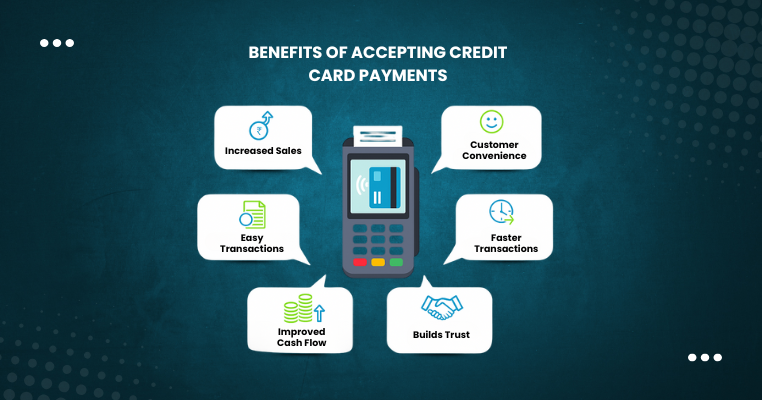
Whether you run a retail shop, an online store, or a startup, accepting credit card payments can help your business grow faster. Here’s how:
- Increases Sales: Customers spend more when they have the option to use credit.
- Improves Cash Flow: Payments are received digitally, so no cash handling issues.
- Builds Credibility: Accepting card payments shows professionalism.
- Supports Online Expansion: With payment gateways like WavexPay, you can reach customers across India.
- Easy Payouts: Settlements and payouts happen automatically to your business account.
- Trackable Transactions: Every payment is recorded digitally for accounting and GST filing.
That’s why small businesses, retail stores, and startups are quickly moving to digital payments.
Common Charges in Credit Card Payments
When businesses accept credit card payments, some charges are involved. Let’s understand them briefly.
- Merchant Discount Rate (MDR): A small percentage fee that banks or gateways charge on each transaction.
- Gateway Charges: Payment gateways like WavexPay may have minimal transaction fees for card payments.
- Settlement Time: Usually 1–2 days for credit card transactions.
- Refund Fees: If the customer cancels or requests a refund, a small processing fee may apply
These charges are small compared to the convenience and trust credit card payments bring.
Challenges in Credit Card Payments
Although convenient, credit card payments also have a few challenges:
- Transaction Fees: Small merchants may worry about MDR.
- Chargebacks: Sometimes, customers raise disputes for refunds.
- Fraud Risk: Phishing or stolen card details can cause issues.
- Settlement Delays: Rarely, payments may take longer to reflect.
However, most of these problems can be solved by using a reliable payment gateways, which ensures secure processing, fast payouts, and fraud detection tools.
Conclusion
Credit card payments have made digital transactions simple, secure, and fast. From a customer’s swipe to a merchant’s payout, several systems — banks, card networks, and payment gateways — work together within seconds.
Whether you are a business owner, freelancer, or retailer, accepting credit card payments can help you grow faster. And with WavexPay, you can easily accept all types of payments — credit cards, UPI, wallets, and POS payments — with instant onboarding and secure payouts.
So, if you want to make your business future-ready, start accepting credit card payments today with WavexPay — your trusted digital payment partner.
Frequently Asked Questions (FAQs)
1. What is a credit card payment?
A credit card payment is a digital transaction where you use your card to buy something now and pay the bank later.
2. How does a credit card payment work?
When you pay, your bank authorizes the amount, transfers it to the merchant’s bank through a payment gateway, and then adds it to your monthly bill.
3. Can small businesses accept credit card payments?
Yes, small businesses can use WavexPay Payment Gateway, Payment Links, or POS systems to easily accept credit card payments.
4. What are the types of credit card payments?
Credit card payments can be online, offline, contactless, EMI-based, recurring, international, or made through payment links and buttons.
5. How long does it take for a business to receive a credit card payment?
Usually, payouts are settled within 1–2 working days through the payment gateway.
6. Are credit card payments safe in India?
Yes, they are very secure due to encryption, OTP verification, and PCI-DSS compliance, which is followed by gateways.
7. What are the charges for credit card transactions?
Merchants may be charged a small Merchant Discount Rate (MDR), which varies depending on the bank or payment gateway.
8. What happens if a credit card payment fails?
If a transaction fails, the amount (if deducted) is automatically reversed by the bank within a few working days.
9. Why should I use WavexPay for credit card payments?
If a transaction fails, the amount (if deducted) is automatically reversed by the bank within a few working days.